What Is A Redan? And Other Cool Design Components Of Shinnecock Hills
Athlon Sports
By Brendon Elliott
There are U.S. Open courses that beat players with length. There are others that squeeze players with rough. Shinnecock Hills does something much more interesting. It makes players think. That is why this week’s U.S. Open is such a fascinating watch, even for golf fans who may not consider ...
There are U.S. Open courses that beat players with length. There are others that squeeze players with rough. Shinnecock Hills does something much more interesting.
It makes players think.
That is why this week’s U.S. Open is such a fascinating watch, even for golf fans who may not consider themselves architecture buffs. Shinnecock Hills is not just a famous old course on Long Island. It is a strategic test built on wind, angles, slopes, ground movement and uncomfortable decisions.
The present layout was designed by William Flynn in 1931, and the course’s official U.S. Open profile notes how Flynn used natural features and prevailing wind to create a routing that constantly changes the type of shot players are asked to hit. Shinnecock is also the oldest incorporated country club in the United States, founded in 1891, and one of the five founding clubs of the USGA.
That history matters. But what makes Shinnecock so cool on television is the design.
So let’s start with one of the most famous words in golf architecture.
What Is A Redan?

USGA/Fred Vuich.
A Redan is one of golf’s classic template holes. In simple terms, it is usually a par 3 with a green angled diagonally, often from front right to back left, with strong slope built into the putting surface. The proper shot is not always directly at the flag. The better play is often to use the ground, land the ball on the safer side and let the contours feed it toward the hole.
That is why Redans are so loved by architects and so frustrating for players. They reward imagination more than perfection.
The template traces back to the famous 15th hole at North Berwick in Scotland, and modern Redans typically feature a diagonal green, heavy slope and deep bunkering that punishes the wrong miss.
At Shinnecock Hills, the seventh hole is named “Redan,” and it is one of the most recognizable holes on the property. For the 2026 U.S. Open setup, the hole is listed at 187 yards. The green angles from front right to back left, with bunkers guarding both sides. The intended play is to use the right side and let the slope feed the ball down and left.
That sounds simple until the player is standing on the tee, feeling the wind, staring at a tucked hole location and trying to decide whether to trust a shot that might land 25 feet from where it eventually finishes.
That is the genius of a Redan. It asks a player to aim away from the final target and believe in the land.
Design Decoder
What Is A Redan?
A Redan is a classic par-3 design where the green sits on a diagonal, usually sloping from the front-right portion toward the back-left.
The play: Land the ball on the safer side and let the slope feed it toward the hole.
The danger: Fire directly at the flag and the green’s angle, bunkers and runoffs can turn a small miss into a stressful up-and-down.
Why The Seventh Is More Than A Famous Name
The seventh at Shinnecock is not long by modern major championship standards. That is exactly the point.
It does not need 240 yards to be intimidating. Its defense is the combination of angle, slope, wind and recovery difficulty. Hit the correct shot and the ball can look like it is being guided by the green itself. Miss on the wrong side and a player can be left with a delicate pitch or bunker shot where par suddenly feels like a small miracle.
It is also a hole with U.S. Open scars. During the final round of the 2004 U.S. Open, the green became so firm and fast that play had to be managed with extra water between groups, a moment that remains part of Shinnecock’s complicated championship history.
That memory is part of why this week’s setup is so interesting. The architecture is plenty demanding on its own. It does not need to be pushed over the edge.
The Wind Is Part Of The Design

One of Shinnecock’s most important design components is not a bunker, green or fairway.
It is the wind.
The official U.S. Open course profile points out that Flynn’s routing includes three sets of consecutive holes that form triangles, which means players face different wind directions throughout the round. It is not simply 18 holes into or down the breeze. The course keeps turning, and each turn changes the question.
That is why Shinnecock rarely feels repetitive. One hole may ask for a held-up iron into the wind. The next may ask for a tee shot that rides the breeze. Another may force a player to judge how much crosswind will move the ball before it lands on a sloped green.
For elite players, wind is not just about club selection. It changes shape, trajectory, spin, landing angle and strategy.
At Shinnecock, the wind is not a condition. It is an architectural feature.
Shinnecock Watch Guide
5 Design Features To Notice This Week
1. Wind-shaped routing: Holes turn in different directions, forcing players to solve a new wind problem over and over.
2. Strategic width: Fairways may look generous, but the correct side of the fairway often matters more than simply finding grass.
3. False fronts: Slightly short shots can roll back off the green and turn a decent swing into a delicate recovery.
4. Closely mown runoffs: Misses do not always stop in rough. They can keep moving, leaving players with multiple shot choices.
5. Blind and semi-blind shots: Shinnecock makes players trust lines, yardages and commitment, not just what they can see.
Strategic Width Is Not The Same As Easy Width
One of the misconceptions about wide fairways is that they make a course easier.
Shinnecock is a great reminder that width can be strategic, not soft. The wider the fairway, the more meaningful the angle becomes. Players are not simply trying to hit grass. They are trying to hit the correct side of the fairway to access the correct portion of the green.
The eighth hole is a strong example. The fairway may look generous, but the better angle into the green comes from the left, which requires players to challenge bunkers from the tee.
That is classic strategic architecture. It gives players options, then attaches consequences to each option.
The safe line may leave a more awkward approach. The aggressive line may open up the green but bring trouble into play. That is much more interesting than simply asking players to hit it straight between two walls of rough.
False Fronts And Runoffs Keep The Ball Moving
Another Shinnecock feature viewers should watch for is how often the ball refuses to stop where players expect it to.
False fronts and closely mown runoff areas are a huge part of the course’s identity. They turn slight misses into decisions. A ball that lands just short can roll 20 yards back. A shot that misses on the wrong side can leave a player choosing between putter, wedge, bump-and-run or a high soft pitch.
The fourth hole’s elevated green is noted by the U.S. Open course profile as an example of the closely mown runoff areas that make Shinnecock so difficult. The fifth green is also perched above the fairway and surrounded by closely mown turf, making misses left or right especially demanding.
This is where Shinnecock separates elite shot-makers from elite ball-strikers.
A great ball-striker can hit greens. A great player can survive when the ball does not quite finish where intended.
Key Holes
Architecture Spots That Could Decide The U.S. Open
No. 7, Redan
The famous angled par 3 where trusting the slope is often smarter than chasing the flag.
No. 11, Hill Head
Short, exposed and visually uncomfortable, with a tiny target that can make par feel like a win.
No. 14, Thom’s Elbow
A downhill tee shot, tilted fairway and demanding angle combine into one of Shinnecock’s sternest tests.
No. 18, Home
A semi-blind closing tee shot with history, pressure and the clubhouse waiting in the background.
Blind And Semi-Blind Shots Add Mystery
Modern championship golf often tries to show players everything. Shinnecock does not.
The course has several shots where players must trust a line, a number or a memory. The ninth begins with a blind tee shot and then asks players to approach a green sitting high on the same hillside as the clubhouse. The 10th also features a blind tee shot to a landing area over the hill. The 18th closes with a somewhat blind tee shot framed by one of the most famous clubhouse views in American golf.
Blindness in architecture can be controversial, but at a place like Shinnecock, it adds character and tension.
It asks players to commit without full visual comfort. That is a different kind of pressure than water left or out of bounds right.
The 11th Is Tiny, Exposed And Brutal
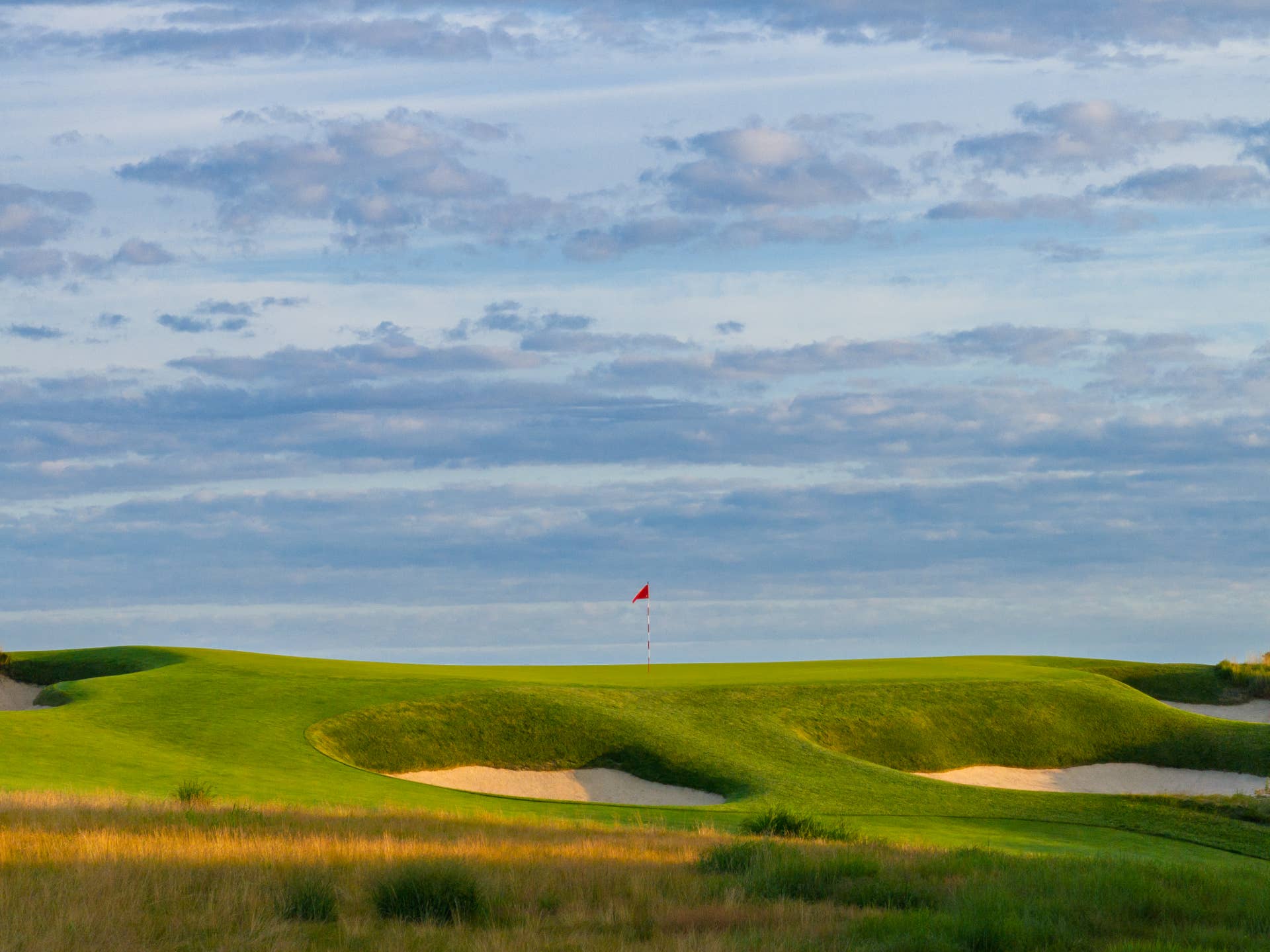
The 11th, named “Hill Head,” may be short on the card, but it is one of the most nerve-racking holes at Shinnecock.
The PGA Tour’s course preview lists it at 157 yards, with the smallest green on the course at 4,280 square feet. It also sits at one of the most exposed points on the property, making wind judgment especially difficult.
That is architectural intimidation in its purest form.
The club may be short. The swing may be simple. The target is not.
This is the kind of par 3 that can make a player feel like he should make 2 and then walk off thrilled with 3.
The 14th Shows How A Fairway Can Fight Back
View this post on Instagram
The 14th at Shinnecock is one of the best examples of how the ground can shape strategy.
The hole drops from tee to fairway, but the fairway itself pitches from right to left while the hole bends slightly left to right. The PGA Tour preview notes that it played as the hardest hole during the 2018 U.S. Open, averaging 4.74 strokes.
That is a great design lesson.
A hole does not have to be complicated to be difficult. When the fairway tilts one way and the ideal shot shape moves another, even a good drive can become uncomfortable. Players who overuse distance without controlling shape and landing angle can find themselves pulled into trouble.
At Shinnecock, the ground is always part of the conversation.
The Coolest Thing About Shinnecock
The coolest thing about Shinnecock Hills is that it does not rely on one trick.
The Redan is famous, but it is only one piece of the puzzle. The wind matters. The angles matter. The width matters. The slopes matter. The runoffs matter. The bunkers matter. Even the partial blindness matters.
That is what separates great architecture from merely hard architecture.
Hard golf can be manufactured. Great golf architecture endures.
Shinnecock has endured because it asks the same timeless question on repeat: Can you see the shot, commit to the shot and accept what the ground does after the ball lands?
That is why the Redan is such a perfect symbol for the place. It is not about overpowering the course. It is about understanding what the course is asking.
At Shinnecock Hills, the smartest shot is not always the prettiest one.
Sometimes, it is the one that lands away from the flag, catches a slope and lets the golf course do the rest.
PGA of America Golf Professional Brendon Elliott is an award-winning coach and golf writer who serves as Athlon Sports Senior Golf Writer. Read his recent “The Starter” on R.org, where he is their Lead Golf Writer. To stay updated on all of his latest work, sign up for his newsletter or visit his MuckRack Profile.
Related: The Monday Mowdown: Shinnecock Hills Brings The U.S. Open Back To The Elements
Related: Golfers Can Bid To Play Oakmont, Baltusrol And More For GHS
Related: All the Ways to Watch, Listen, Read and Scroll the U.S. Open This Week