

(Bloomberg) -- CoreWeave Inc. has raised $8.5 billion from a group of banks and investors to help finance an expansion of its cloud computing capacity in what the company says is the largest chip-backed debt deal of its kind.
The investment-grade rated loan is secured by a combination of microchips, such as graphics processing units or GPUs, and a customer contract to use the chips, according to a statement Tuesday. Bloomberg previously reported that the debt is backed by contracts with Meta Platforms Inc. worth at least $19 billion.
CoreWeave can initially borrow up to $7.5 billion, which then increases to $8.5 billion once the chips are up and running. The high-yield rated company had already amassed a $21.6 billion debt pile as of the end of last year, along with an additional $3.7 billion of untapped borrowing capacity, according to its annual report.
A group of banks and other institutions led by Mitsubishi UFJ Financial Group Inc. and Morgan Stanley provided the new loan. Goldman Sachs Group Inc. and JPMorgan Chase & Co. also joined the transaction. Blackstone Inc., which has been involved in similar CoreWeave deals, was an anchor investor.
Shares of CoreWeave rose as much as 6.2% to $73.43 in early trading Tuesday. Rival neocloud provider Nebius Group NV extended an early gain to 7.3% before the US market opened.
The loan is the latest example of an industrywide debt binge as technology companies find new ways to raise money for constructing the underpinnings of the artificial intelligence boom. Conservative estimates peg a wave of AI spending at $3 trillion or more, and the microchips can cost multiple times more than data centers they go into.
“There is just so much demand for this infrastructure, it’s truly not stopping,” said Brannin McBee, chief development officer and CoreWeave co-founder, in an interview. “This type of financing that we are doing is the most sophisticated and scalable way to finance the build-out of artificial intelligence infrastructure.”
The Livingston, New Jersey-based CoreWeave has dramatically ramped up its borrowing in recent years to finance deals in which it rents access to high-end artificial intelligence processors. Using chips and related contracts to back its debt allows the company to get significantly cheaper borrowing costs. And winning a high-grade rating on a debt deal opens up access to a wider swath of investors.
The market for GPU loans, which are typically unrated, is nascent but expected to balloon in the coming years. While data are scarce on what are often private deals, CoreWeave’s $8.5 billion facility is the largest completed transaction so far, according to the company.
Lenders view debt secured by microchips as a safer way of putting money to work — especially when backed by a contract from a highly rated company such as Meta. The money from the contract creates cash flow to fund interest payments and pay back debt.
Typically these deals are structured so that a special purpose vehicle is used to raise the funds and owns the chips, and the debt is paid back in full over the life of the loan.
Cheaper Borrowing
CoreWeave’s loan received an A3 rating from Moody’s Ratings, placing it solidly in the investment-grade category, allowing insurance firms — which have stricter capital requirements — to buy the debt. Banks, asset managers and insurance investors participated in the transaction.
This is the fourth GPU loan that CoreWeave has raised. The Meta contract and investment-grade rating helped the company lock in a cheaper interest rate. The facility has two portions: a floating-rate tranche with a margin of 2.25 percentage points over the Secured Overnight Financing Rate, and a fixed-rate tranche financed at about 5.9%.
The new loan’s borrowing rate is about 7.5 percentage points cheaper than the first GPU loan CoreWeave did in 2023, according to Nick Robbins, vice president of corporate development.
“Being able to borrow at an investment-grade cost of capital is strategically important,” Robbins said. “Dragging down our cost of capital has long been one of the imperatives for our business as we grow.”
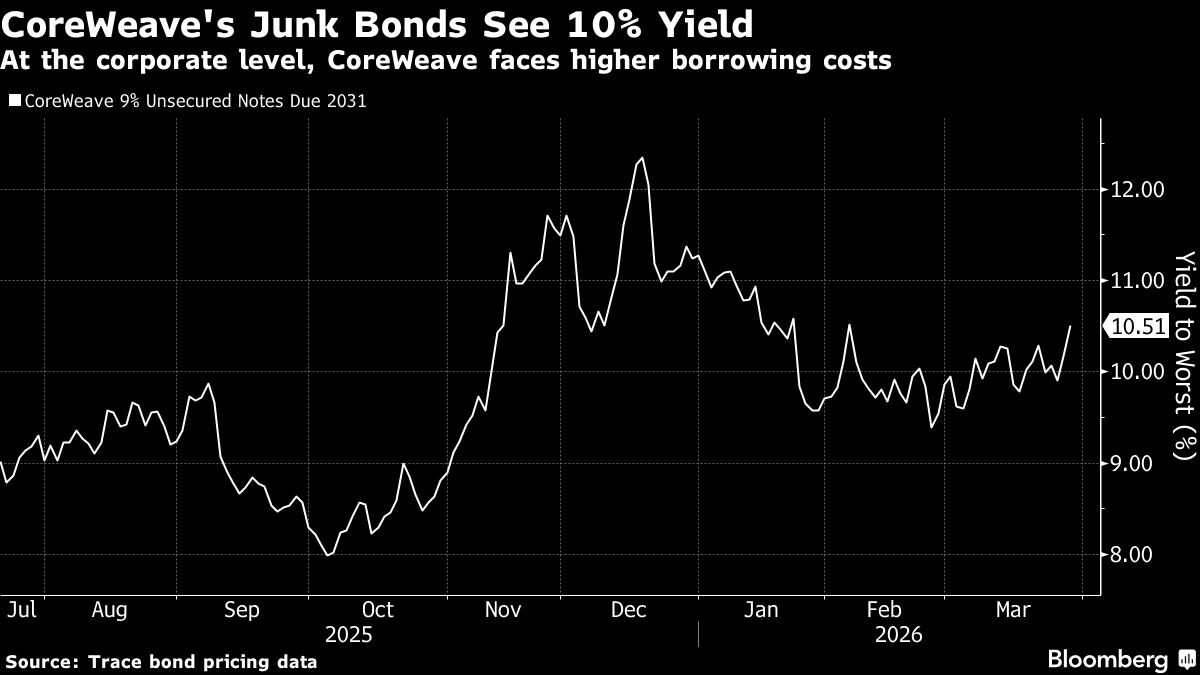
That’s much cheaper than at the company level, where CoreWeave carries a high-yield rating from each of the top three credit ratings firms. The company sold two junk bonds last year which currently trade with a yield of around 10%. The average junk bond has a yield of around 7.7%, according to a Bloomberg gauge. CoreWeave has also tapped the convertible bond market.
CoreWeave’s new facility is in the form of a delayed-draw term loan, so the company can choose to draw the full amount over a period of time. The deal was oversubscribed, meaning there was more investor demand than the $8.5 billion figure. The loan matures in March 2032.
--With assistance from Dina Bass.
(Updates with share movement in fifth paragraph.)
More stories like this are available on bloomberg.com
©2026 Bloomberg L.P.